Wednesday, March 30, 2011

Elephants in the closet part 2, Ethanol

We hear a lot of negative press about ethanol, to be honest I have some questions myself. However, even though some of my fellow livestock producers in other states grumble about the effect ethanol has had on their production costs. Its not been a bad deal for me or our state. Today's blog will probably leave you with more questions than answers, so it's a good thing our Ag session is next week. When a bushel of corn is fermented into ethanol you get about 1/3 alcohol, 1/3 distillers grains, and 1/3 CO2. If you are close to a plant you can use the wetter, less expensive distillers by products because of the cheaper freight relative to dry matter of feed. This is a good deal for me because I have an ethanol plant and a commodity broker less than 6 miles from one of my farms. Its also a good deal for the plant because drying the distillers grain requires a good amount of energy from coal or natural gas.

Today on the farm I hauled wet distillers solubles (syrup) to the cows. This is the most economical by product available from the ethanol plant for the digestible protein needs of my cows. The product is cheap because it is only about 40% dry matter. I am only 6 miles from the plant so this is a good option for me, for my friends that are more than 100 miles away using your freight budget to move a wet commodity can be a losing proposition.

Here is the plant, this is one of several in our state. Ethanol has increased demand for corn by nearly 40 %.  The million dollar question is, does it take more energy to make ethanol than is contained in ethanol? I am a corn buyer and this demand has caused the price to more than double since harvest. Corn is currently at about $6.20 per bushel down from a $7.00 high at the beginning of this month. An interesting side note this is only the 3rd time in my 17 years of raising cattle that I have had to buy corn at above the cost of production. The farm program made cheap corn and many industries were built around this. This is also going to have some impact on food price. Although I believe demand from the growing Asian economies will have a far greater impact on our food prices. I think the cheap food we have grown accustomed to in this county is coming to an end. I also think ethanol is going to take an unfair amount of the blame.

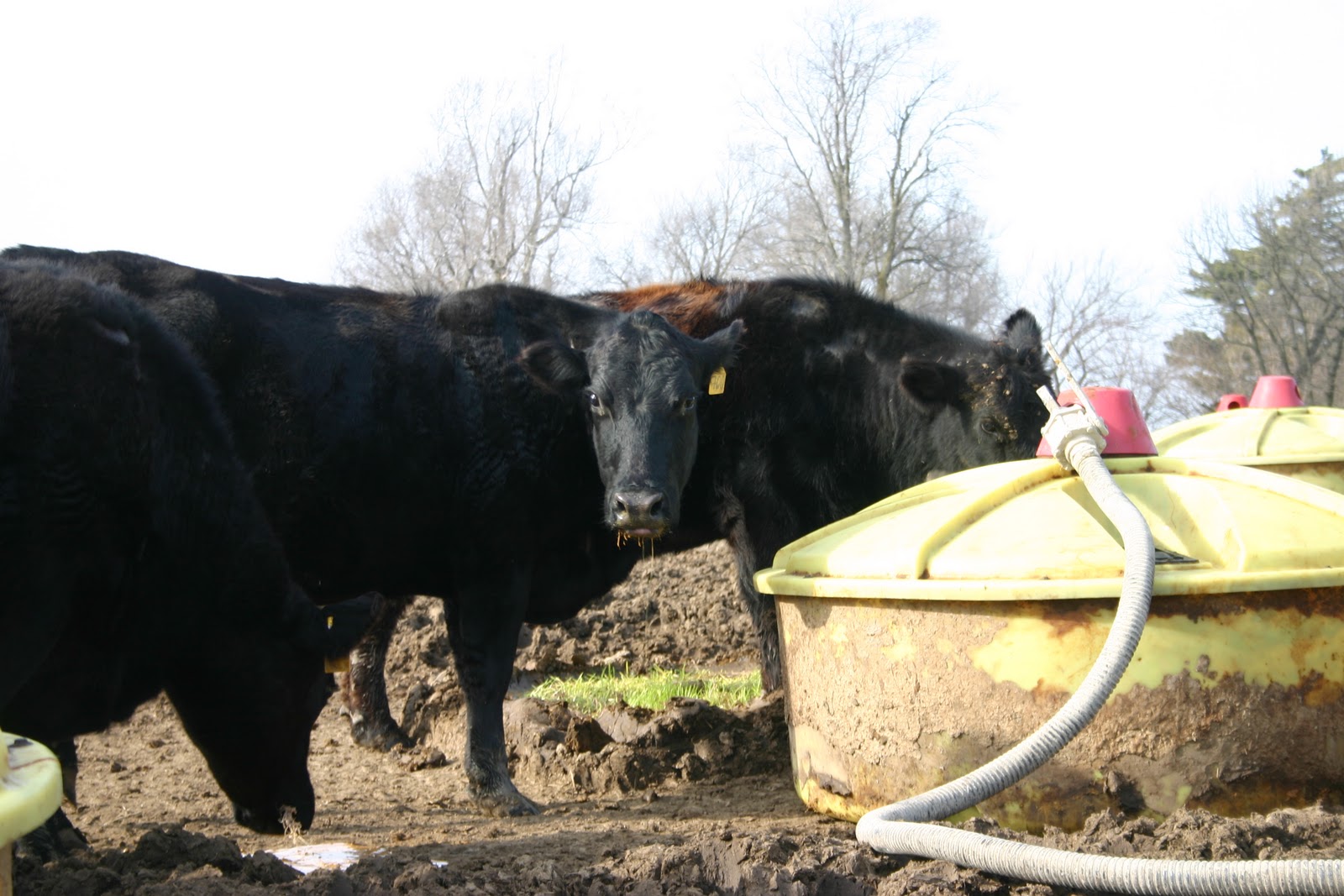
Loading syrup for the cows. When the grass is dormant in the winter cows need supplemental protein to break down the fiber in the dormant grass. The by products from ethanol production are the best protein supplements I've ever used. Next question, when figuring net energy gain on ethanol production do they account for the feed I get to put back into the cattle? The conversion on the by products is superior to corn.


Commodity shed storing the different by products, wet gluten, dry gluten, wet distillers grain, etc.... regular by product buffet.
The ethanol plant in Shenandoah has started to capture the CO2 to produce algae for bio fuels. As much as I don't like the high corn I believe that as we start to utilize the by products from ethanol we will continue to see a greater net energy gain from ethanol production.


Cows enjoying their tasty syrup, we feed the by products to the calves as well. The dogs even like it.


This is what I don't like about $7.00 corn. There is a considerable amount of marginal land that was good pasture being converted to crop production. The few producers who choose to do this are taking a short term gain with severe long term consequences. But it's our demand for energy that's causing it. The American consumer wants cheap food and cheap energy. I am confident that we can feed a growing world. I also believe we will develop new forms of energy. But, I do believe it will take a greater percentage of our income to have these things.

Keep in mind that raising crops for energy is really nothing new. Until WWII between 20% and 30% of our acres were dedicated to raising oats to feed the horses that provided transportation and power to pull farm equipment. We have been able to use fossil fuels to increase yield yet there supplies are dwindling. Unless someone can present a better solution. In spite of the unknowns I believe the ethanol industry is moving in the right direction and that it I deserves our countries support.

Farming and your health

 I mentioned in a previous blog that I would try to share information about the people I work with that have a positive impact on my business. This project would not be complete if I did not mention my Yoga teacher Sara.

I love what I do, however, about four years ago I realized if I want to be able to raise cows the rest of my life I needed to take better care of myself. The abuse your body takes from jumping on and off equipment, walking in mud, lifting heavy things, working long odd hours, and worrying about markets can take it's toll if you let it. On top of all this I believe that the beef I raise is a nutritious product that can be part of a healthy lifestyle. I owe it to myself and my Industry to actively live healthy.

Today after my my work was done I went to yoga class. Here I am with my instructor Sara. Sara has a degree from ISU in fitness, she is an excellent instructor who has had a major impact on my health and therefore my business, as well as the lives countless others in our community. To have an individual with her talent in  a town our size is a treasure.

Yoga is an excellent activity that is good for mind and body alike. If you don't stay flexible your going to wind up with back and knee injuries from farming. These injuries are costly and would keep me from doing what I love. Furthermore, an hour of yoga allows me to clear my mind of the issues of the day. I always make better decisions after class.

I've mentioned earlier that farming is a competitive business. Being able to outwork my competition is important. Taking care of my fitness needs is another angle I work to stay ahead of the game.

Monday, March 28, 2011

Elephants in the closet part 1, The farm program

Heifers should finish calving in the next few days and our ag session is just over a week away. This means I will be wrapping this project up soon. Before I do I want to try to give my perspective on two of the biggest issues in the news about agriculture. One is ethanol, which I'll try to cover Wednesday. The other issue which I'll cover today is The Farm Program (Subsidies).

Today on the farm I went to the USDA Farm Service Center. This center houses two different government agencies. They are the NRCS (Natural Resource Conservation Service) this agency is responsible the implementation and funding of projects relating to conservation, resource enhancement, and water quality improvement. The work this agency does protects our land and water. I believe we all benefit from the work of the NRCS.

The other agency is the FSA (Farm Service Agency) They are responsible for managing farm subsidy payment to farmers, ranchers, and land owners. They also administrate low interest beginning farmer loans (for the record I never got one). From my capitalist perspective I don't believe these programs have been good for agriculture in what is supposed to be a free market economy. The one aspect of the FSA that I believe is very good and once again benefits all of us is that so long as a producer is enrolled in the Farm Program the FSA is able to regulate that individuals farming practices to protect and preserve our soil and other natural resources. Of course the only leverage they have is to take away the farm payments, which puts my feelings in a catch 22.

The nations need to protect our land is one of the interesting aspects of my business. If someone owns a business in town and they neglect and abuse their property they will probably go out of business, but someone will be able to purchase the property and in a matter of months be able to improve it. Maybe even make it like new again. If a farmer uses poor conservation practices on his land and erodes the topsoil he will most likely go out of business as well. The difference is it will take 1,000 years to rebuild each inch of lost topsoil. This is why I believe in some regulation of how we farm. If you are a poor manager you don't just hurt yourself you hurt everyone.

The Farm Program came about because of the Dust Bowl. This man made phenomenon was probably the worst disaster in the History of our country. If you would like to learn more about the dust bowl and why the farm agencies were formed I would recommend this book: "The Worst Hard Time" By Timothy Egan

Here I am in the FSA office holding my USDA form ccc 927. Official government documentation that I'm a farmer.

The purpose for my visit was to line up funding for conservation work. I am building ponds this summer to control a ditch. This will stop sediment and help keep the water in our river clean. To do this I have agreed to take land out of production and pay 50% of the cost of building the pond. You the tax payer contribute the other 50%. I believe we all benefit from clean water and I support this kind of work. 

Regaurdless of my personal beliefs, as long as there is a farm program, the FSA side of the office is an agency I will have to deal with. My competition uses it so I use it. Otherwise I am at a disadvantage when competing for acres.

Here's one of the happy FSA employees.It's always important to remember that the people who work in these offices might not like some of the programs any better than you or I would. They do a very good job and are very helpful to me. Just because someone works for the government is no reason to treat them poorly. They have to work through the bueraucratic maze and then help all of us understand it. To get along try to learn their language (government acronyms), Be patient, rules change for them on a daily basis.  Be a student of the programs yourself, and send them chocolates on Valentines day.

Sunday, March 27, 2011

The Birds and the Cows

For some reason the you will have to click on the boxes to make the photos show up. If anyone can help let me know. Thanks

Because of the drastic increase in corn prices over the last year I have decided to try to wean more of my calves on grass, and let them graze to heavier weights than I have in the past. Our current practice has been to place a calf in the feedlot at 205 days of age and leave him there until harvest at about 13 months of age. The cowboy in me really likes going back to weaning on grass. The whole purpose of a ruminant animal like a cow or buffalo is to convert the suns energy through grass into digestible protein. Cheap corn has made me adjust my management to fit my resources and now I'm going back to a system that has worked for thousands of years. OK I'll get off my soapbox and talk about what I did today.

Today on the farm we cut hedge posts. If I'm going to graze more calves I have to have more fence. More fence means more posts.The main reason I was out doing this on a Sunday was to get the posts cut before the birds start nesting in May. Because of this we stop cutting hedge by the first of May so we don't interrupt the nesting habits of the birds that live on Pinhook Farm. The other management practice we apply to encourage nesting is the stockpiling (allowing grass to grow for several months to use later) of pasture. I'll try to explain through the photos how all of this fits together.

Here is a photo of Kevin cutting down a hedge tree. The farm we are working on was recently acquired and had been neglected for several years before our purchase. When land is neglected or abused Mother Nature steps in and protects it by covering it with hedge and locust trees. These thorny trees prevent animals from grazing to close and allow the land to rest. Hedge is a very dense wood and makes excellent fence posts. I'm sure most of you have seen the gnarled crooked posts holding up miles of fence across our state. The green hedge balls that you see for sale in the fall as a natural pesticide for bugs and crickets come from these trees as well. I think you can see in the photo what excellent habitat these trees are for birds. (Don't worry we leave the trees along the ditches and streams. We just clear the open areas.

Were convinced this is the straightest hedge post on the planet :) you never know what a farmer will be proud of.


Many you may have noticed that there is not a lot of mud on the farm. This is because one of our management practices is to restrict grazing on our calving pastures from early May till around the first of August. This practice gives my calves a clean, dry place to be born. It saves on equipment by allowing the cows to harvest their own feed, and it gives the birds nesting habitat.


Birds and cows are part of a natural ecosystem. The flies follow the cows. Then the birds eat the flies. Most ranchers know that a diverse ecology is essential to a profitable cow calf operation. I don't entirely understand how all this works. I just know that my balance sheets tell me so.


The next benefit I get from restricting summer grazing is an abundance of wildflowers and pollinators. These flowers are habitat for bees and other flying insects that spread the pollen that boosts my forage yields. Nature is all about give and take, and she gives so much if you just give her a chance.


I don't know how many different kinds of birds the ranch now sustains. I am fascinated by watching them and someday hope to learn more about them. I hope this little blue bird of happiness is a reminder of the role agriculture plays in protecting our natural resources.

Saturday, March 26, 2011

Veel Hoeden

I first learned about the word Veel Houden at our opening session in Pella. This expression is the Dutch phrase for "many hats". This is an excellent way to describe a typical day for a farmer. As the day progressed I became increasingly aware of how many different skills a farmer needs to stay competitive in today's farming environment. Since it was a Saturday I was not bothered by the daily grain and livestock markets and the decisions that go with them. There is enough of that during the week. However thanks to cell phones I was able to work on a pasture lease, finalize the terms on a real estate contract, and procure a group of feeder cattle. All of this was accomplished while I was feeding cows, tagging calves, and working on equipment. This kind of variety in my daily life is another of many reasons that I truly love what I do.

Equipment maintenance and repair is ongoing. The conditions we operate in are less than ideal, mud, snow, extreme cold, extreme heat, or dry and dusty. With shop rates exceeding $80 per hour it's best to learn to wear a mechanics hat and do as much as you can yourself. In this photo I've just finished diagnosing a charging system problem which turned out to be a bad cell in the battery. The repair was to replace a $150 battery. Which believe it or not was a relief. Any time you can leave the parts store for under $500 its a good day on the farm. Just for the record. I have two John Deere tractors besides the Valtra I'm working on. They break down as well.


When I sent one of my helpers to town for the battery I accidentally left my calving record book in the truck. To keep working and get the calves tagged while he was gone I had to improvise and use my "Farmers Palm Pilot".

Friday, March 25, 2011

Heavy March Snow

One sure thing about March in Southern Iowa is the weather can change quickly. If you remember the photo of the calf in yesterdays blog it was a warm, sunny, spring day. By 2:00 AM we had 4" of snow on the ground and a gentle sleet was falling. I've mentioned the code of the west in previous blogs. To learn more about the code google Gene Autrey's Cowboy Code its outstanding. On days like this livestock producers follow commandment number 4. A cowboy must care for and be gentle with children, the elderly, and animals. For some reason weather systems tend to make cows have babies. There are lots of photos today so follow along and I hope enjoy.


I found this pair at about 7:30 this morning. The mama had dried her calf off and was doing a good job. However a cold wet snow is no place for a new baby and I knew all parties would feel better if they were in the comfort of a dry barn.


Mama cows are very nurturing of the babies. One of the easiest ways to move a pair (cow and calf) is to put the baby in the back of the ranger where the cow can see and smell it. Once she knows where her baby is I believe you could lead her anywhere.


 Here she's found, seen, and smelled her baby. Now were ready to move out.


Following


Taking a break to make sure her calf is safe.


Arrival at the lot in front of the barn after about a half mile walk.


Warm, dry, and enjoying a treat in the barn.


While I brought up the pair Kevin unrolled old bales of hay for the cows to lie down on. This simple husbandry practice is a great comfort to the cows on a snowy day like today.


Cows eating and wallering in their bedding.


 I'm sticking my finger in this calf's mouth to make sure he is not chilled. This is a somewhat crude but effective way to decide if a calf should be brought to the barn. This calf was good to go and proceeded to find some of the fresh hay to bed down in.


 The best thing about most spring snow storms is they don't last long. This was taken about 5:30 this evening. The snow was gone and the calves were still being born.

Thursday, March 24, 2011

This is about what my on road diesel bills are every 3 to 4 days. This is not going to be one of those woe is me the poor farmer has so many challenges blogs. I've never been a fan of that attitude. Anyone in business faces a variety of unknown costs and suprises on an almost daily basis. The challenge of a free market is to navigate these obstacles so you can prosper and continue to grow your business.

My concern with fuel price is it has been a very strong indicator of consumor demand for beef. Any family budget only has so much money for fuel and so much money for protien (ideally beef). As the fuel budget is stretched competeing meats (pork, fish, or god forbid chicken) become alternatives because of their lower cost. I'm a beef producer so I can't believe anyone would actually do this for taste :) Beef prices at the supermarket are going up because of simple supply and demand. Corn is short and high, cattle inventories are at the lowest level since the 1950's, crude oil is high, and our population is growing. As I look towards summer I know that a small shift in demand for  beef could mean large financial losses for me because of the high level of production costs associated with corn and crude oil. This is starting to affect my expansion plans instead of wanting to borrow money to build a new shop I'm thinking save another couple of years. I need to replace a 4 wheeler, but now my thoughts are becoming wait till fall see what happens.

On the flip side if the consuming public decides they are going to look at ways to trim their fuel budget, walk to work, ride a bike, carpooling, etc... they would have more money left over for tasty backyard grilling this summer. Beef prices would stay at profitable levels and the drop in demand for crude would help solve their high fuel prices. But the reality is no one knows what the consumer is going to do.

All this analysis was starting to clog my brain. After watching the calves play in the sun this afternoon I was reminded that while high fuel costs are a concern, in the greater scheme of things they aren't that big of a deal.